“What it is”
I Heard You Paint HousesWhat it is is a coded expression through which a seemingly ordinary phrase can convey a threat, a warning, or acceptance of a deadly course of action. In Frank Sheeran’s account, its meaning is not contained in the words alone: it depends on shared knowledge, tone, timing, and the danger that direct speech would expose. The expression matters most in the exchanges surrounding Jimmy Hoffa’s attempt to regain control of the Teamsters, where Russell Bufalino’s warning is delivered indirectly, and Sheeran later recognizes the practical meaning of an even more chilling conversation about Hoffa’s disappearance.
Meaning and Use
Sheeran identifies the phrase as part of a shared way of speaking rather than as a formal code with a single fixed translation. After Russell Bufalino tells him to speak to Jimmy Hoffa, Sheeran explains that the instruction to tell his friend “what it is” amounted, in their way of speaking, to a death threat. Its force comes from what is left unstated. Bufalino does not announce a plan or spell out a consequence; he gives Sheeran a message to carry, and expects both Sheeran and Hoffa to understand its stakes.
That indirection makes the phrase effective as both communication and deniability. Sheeran can repeat the warning while leaving its lethal implication implicit. Hoffa, in turn, can answer the threat as a challenge without requiring either man to name the danger explicitly. The expression therefore does more than describe a situation. In context, it helps deliver a threat and tests whether the listener will accept or resist the meaning carried beneath the words.
The Warning to Hoffa
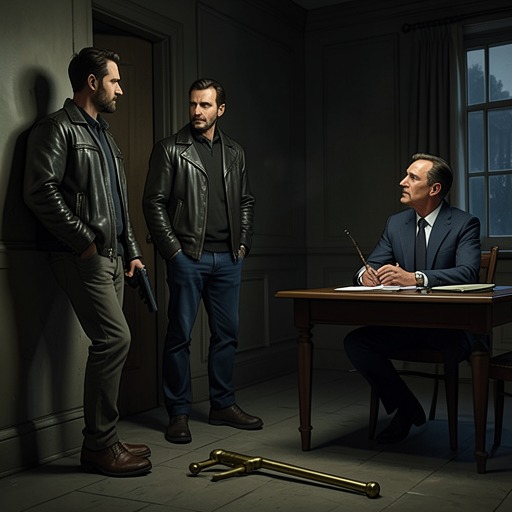
The exchange follows a sit-down at which Hoffa insists that his effort to retake the union is not about money: “It’s not about the money. I’m not letting Fitz have the union.” Russell Bufalino takes Sheeran aside afterward and tells him, “Talk to your friend. Tell him what it is.” At the Warwick Hotel, Sheeran warns Hoffa that, if he continues pursuing the union, he should keep people around him for protection. Hoffa replies that he will not expose his family to danger, but then insists that nobody scares him and that he intends to defeat Fitz in the election.
Sheeran makes the implication unmistakable by reminding Hoffa that Russell himself had told him to explain what it was. Hoffa’s answer, “They wouldn’t dare,” turns the warning into a direct contest of resolve. Sheeran later recalls Hoffa’s glaring eyes and growling delivery, and describes the rest of the night and breakfast the next morning as a stretch of distorted talk that might, in retrospect, have been nervous. The recalled bravado and the narrator’s later knowledge sit uneasily together: the warning was understood, but Hoffa refused to behave as if understanding it meant submission.
The phrase also frames Sheeran’s later attempt to reach Hoffa at his cottage in Lake Orion. Nine months after the testimonial dinner, Sheeran is in his Philadelphia kitchen with the telephone in his hand, hoping Hoffa will reconsider taking back the union while there is still time. That recurrence gives the expression a narrative afterlife: what began as a message delivered in person becomes the meaning Sheeran hopes a telephone call might still avert. The account does not present the warning as a guarantee that Hoffa will yield; it shows instead that the message has been conveyed and that Hoffa continues toward the course that made it urgent.
From Warning to Foreknowledge
In a later conversation with Russell Bufalino, Sheeran raises the danger of federal consequences if Hoffa’s body is found. He says Hoffa has records hidden away in case something unnatural happens to him. Russell answers, “Your friend made one threat too many in his life,” and Sheeran presses the point: “I’m only saying the nuclear fallout’s going to hit the fan when they find his body.” Russell replies, “There won’t be a body.” He moves his remaining thumb against the tablecloth, a gesture set against the fact that he had lost the thumb and index finger on his left hand when young, and says, “Dust to dust.”
Sheeran’s response, “That’s what it is,” registers acceptance without supplying an explicit account of what has been decided. Russell then pinches Sheeran’s cheek and tells him they had done all they could for Hoffa, that nobody could tell the man what it was, and that they would go into Detroit together on Wednesday night. He adds that they will stop for the women along the way and do some business. Sheeran understands that Russell has business along the route from Kingston to Detroit; the women will wait at a roadside diner while the men leave to attend to it.
Read together, these moments shift the expression from warning to grim recognition. In the first scene, Sheeran carries an implied threat to Hoffa; in the later exchange, he hears the implication in Russell’s statement that there will be no body and accepts the journey to Detroit. The phrase does not itself reveal every detail of the plan. Its significance lies in how the speakers use shared understanding to move toward action while keeping the action largely unspoken.
A Wider Language of Implication
The account shows the same communicative method in a separate episode involving Whispers DiTullio. Angelo tells Sheeran, “It’s your responsibility to take care of this matter by tomorrow morning. That’s the chance you get. Capish?” Sheeran agrees, and Angelo adds, “You gotta do what you gotta do.” Sheeran explains that no special instruction was needed to understand the command: he compares it to a military officer sending German prisoners behind the line and telling a soldier to “hurry back.” The next morning, Whispers is found shot at close range on the sidewalk.
This episode is not the same exchange as Russell’s warning to Hoffa, but it clarifies the larger speech system in which What it is operates. An indirect instruction can be intelligible precisely because the listener knows what action the euphemism conceals. In the Hoffa scenes, Sheeran supplies the interpretation himself, describing Bufalino’s words as a death threat and later accepting a journey whose purpose is left indirect. The book’s retrospective telling makes that interpretation part of the evidence while also locating it within Sheeran’s account, rather than presenting the code as a neutral phrase whose meaning can be separated from the narrator and circumstances.
Narrative Significance
What it is links speech to allegiance and consequence. Sheeran is not merely a messenger between Bufalino and Hoffa: he is the person who understands the warning, delivers it, later voices concern about the consequences of Hoffa’s death, and finally accompanies Russell toward Detroit. The repeated indirectness lets loyalty and resistance appear in the same scene. Hoffa hears the danger and answers defiantly; Sheeran warns him, then remains bound to the men whose implied intentions he has helped convey.
The phrase’s importance also depends on retrospective narration. Sheeran’s account presents the early warning alongside later statements about a body that will not be found and a Wednesday-night trip to Detroit. The reader can therefore hear more in the earlier words than Hoffa’s defiance allows them to settle at the time. What it is is both a piece of criminal shorthand and a narrative hinge: a small, ordinary-sounding phrase that gathers meaning as the threatened outcome approaches, while leaving the decisive acts veiled in the same silence that made the warning possible.